

UPCOMING PROJECT

A DEVOTEE AND HIS POETRY
When the world questioned his words, the Lord embraced his poetry.
In the 12th century, in the sacred land of Kalinga, lived a poet whose devotion to Lord Jagannath would eventually become immortal through his words.
He was not merely a scholar of Sanskrit or a composer of beautiful verses. He was a man who experienced devotion through emotion, music and poetry. His understanding of the Divine was deeply personal, and he believed that love itself could become the purest form of worship.
It was this belief that inspired him to compose the Gita Govinda.
But Jaidev’s poetry was unlike the conventional devotional compositions of his time.

WHEN DIVINE LOVE CHALLENGED HUMAN THINKING
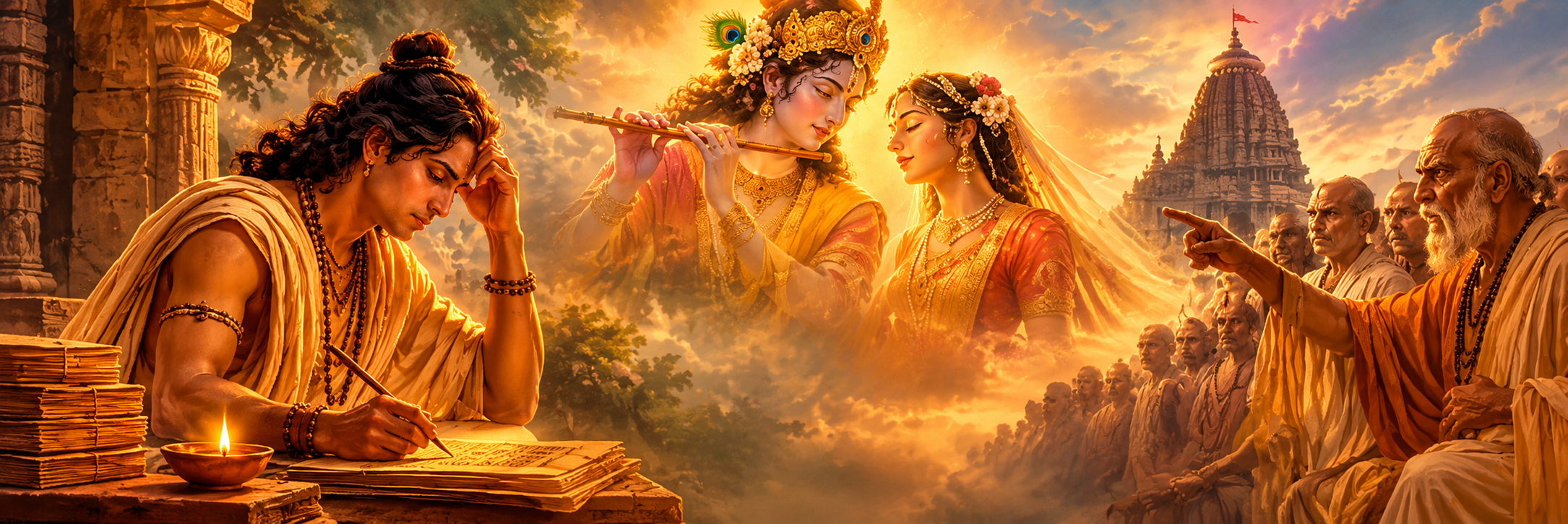
The Gita Govinda explored the intimate relationship between Radha and Krishna. It spoke of longing, passion, separation, jealousy, forgiveness and surrender.
Jaidev portrayed Krishna not only as the Supreme Lord but also as one who experienced the pain of separation, yearned for Radha’s love and sought her forgiveness.
In one of its most extraordinary expressions, Krishna bows before Radha and asks her to place her feet upon His head.
For a society accustomed to seeing the Divine primarily through the language of reverence, hierarchy and distance, such poetry could be difficult to accept.
How could the Supreme Lord surrender before a woman?
How could poetry describing the intimate emotions of lovers become an offering to God?
Could human love and divine love be expressed through the same language?
These were the questions surrounding the unusual beauty of Jaidev’s creation.
His poetry could be interpreted by some as worldly and sensual, while Jaidev understood it as an expression of the highest spiritual love.
The conflict was not simply about poetry. It was about the way people understood devotion itself.
THE VERSES THAT HUMAN BEINGS QUESTIONED
Jaidev continued to compose, guided by a devotion that did not seek approval from the world.
His verses became the Gita Govinda, a composition of extraordinary lyrical beauty, musical structure and spiritual depth.
Tradition remembers the opposition and hesitation that such an unconventional portrayal of divine love could provoke. For a dramatic retelling, this becomes the central struggle of the poet: a man whose devotion was misunderstood by the very society in which he lived.
Yet Jaidev remained convinced that his poetry belonged to Jagannath.
He was not writing to please the learned, impress the royal court or win the appreciation of society.
He was writing for his Lord.
JAGANNATH ACCEPTED WHAT THE WORLD COULD NOT UNDERSTAND
Among the most celebrated devotional legends associated with Jaidev is the story of the unfinished verse.
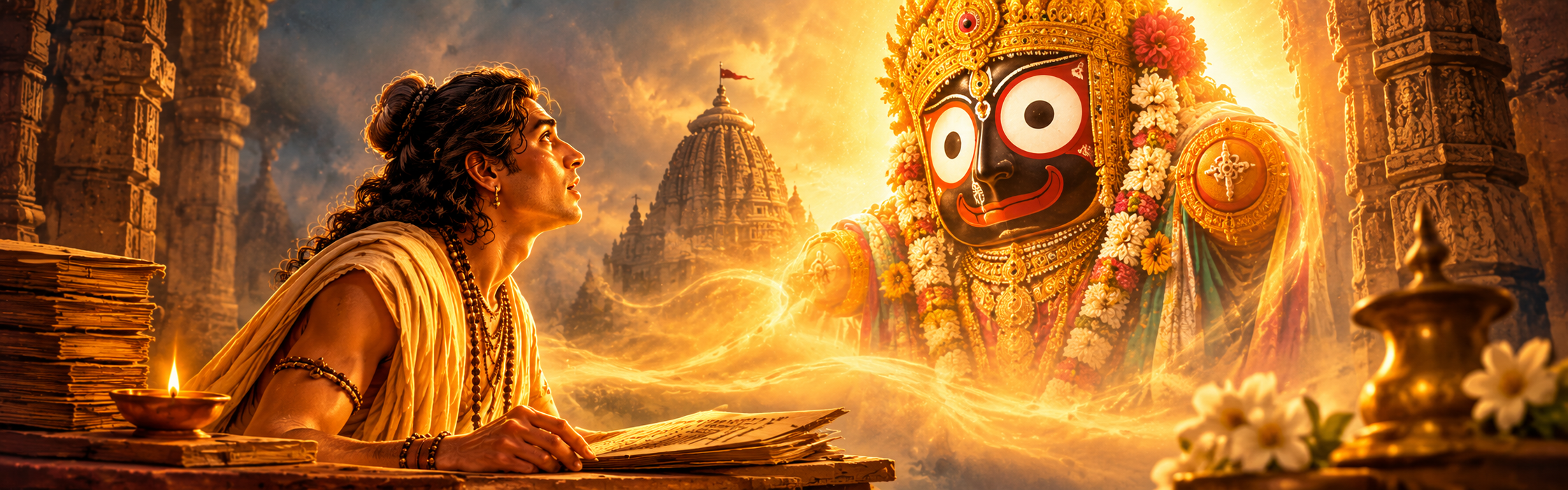
While composing the Gita Govinda, Jaidev reached a line in which Krishna would ask Radha to place her feet upon His head.
The thought troubled him.
How could he write such a thing? How could the Supreme Lord, worshipped by the entire universe, speak of surrendering His head at the feet of Radha?
Unable to resolve his hesitation, Jaidev left his manuscript and went away to bathe.
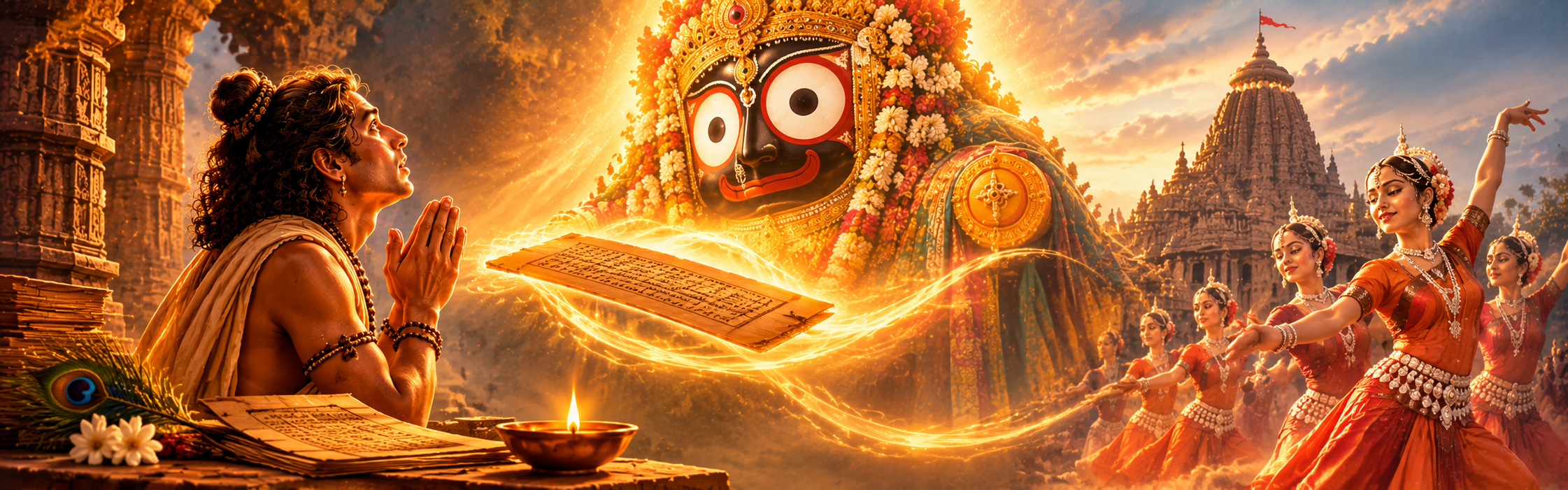
During his absence, according to the devotional tradition, Lord Krishna Himself appeared in Jaidev’s form and completed the verse.
When Jaidev returned, he discovered that the unfinished composition had been completed in his own handwriting.
The words were:
Dehi Pada Pallavam Udaram.
The meaning was an extraordinary expression of surrender: Krishna asking Radha for the blessing of her tender feet.
Jaidev understood that something beyond human explanation had taken place.
The Lord had written the very words that His devotee had hesitated to write.
For Jaidev, this was the ultimate acceptance.
The poetry that questioned conventional ideas of divine hierarchy had received its answer from the Divine Himself.
Divine Himself.
THE LORD’S ACCEPTANCE BECAME ITS IMMORTALITY
The greatness of Jaidev’s poetry was not confined to the moment of its creation.
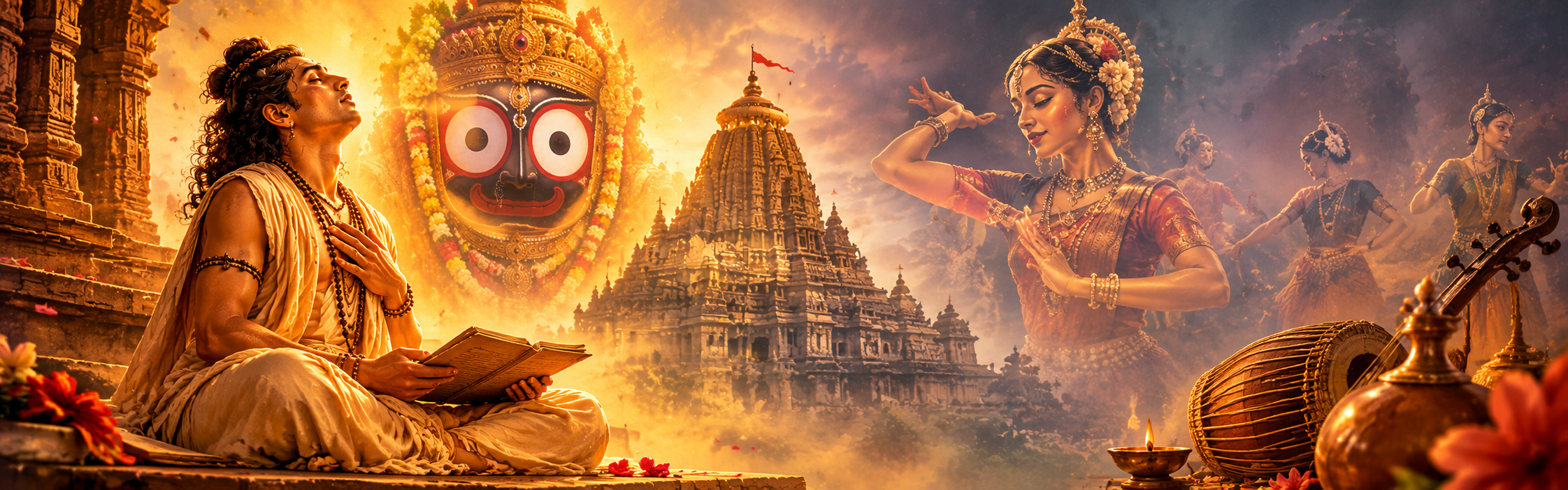
The Gita Govinda became deeply associated with the worship of Lord Jagannath at Puri. Its verses found a place in the temple’s devotional and musical traditions.
What was once a bold poetic expression became an offering to the Lord.
Its songs were sung. Its emotions were expressed through dance. Its verses travelled through generations of musicians, poets and devotees.
The compositions became an important foundation of Odisha’s musical and artistic heritage, particularly influencing the expressive traditions of Odissi.
The poetry that could be questioned for its language became celebrated for its spiritual depth.
The words that described love became an expression of devotion.
And the poet who wrote for Jagannath became immortal through his creation.
BEYOND THE JUDGMENT OF TIME
Today, centuries after Jaidev’s lifetime, the Gita Govinda continues to resonate in the sacred traditions of Odisha.
Its verses are still associated with Lord Jagannath. Its musical compositions continue to inspire Odissi dancers. Its portrayal of Radha and Krishna remains one of the most beautiful expressions of divine love in Indian literature.
Perhaps the greatest message of Jaidev’s journey lies here:
Human beings may judge devotion through their own understanding. They may question its language, its expression and its form. But true devotion does not always fit within the boundaries created by society.
Jaidev wrote what his heart felt for Jagannath.
And through the centuries, his poetry found its place not merely in books, but in the living traditions of a civilisation.
The world may question a poet’s words. But when those words become an offering to the Divine, time itself cannot erase them.
JAIDEV — A DEVOTEE WHOSE POETRY BECAME IMMORTAL.
JAI JAGANNATH
FOLLOW / DM INSTAGRAM : hariharaproductio
